
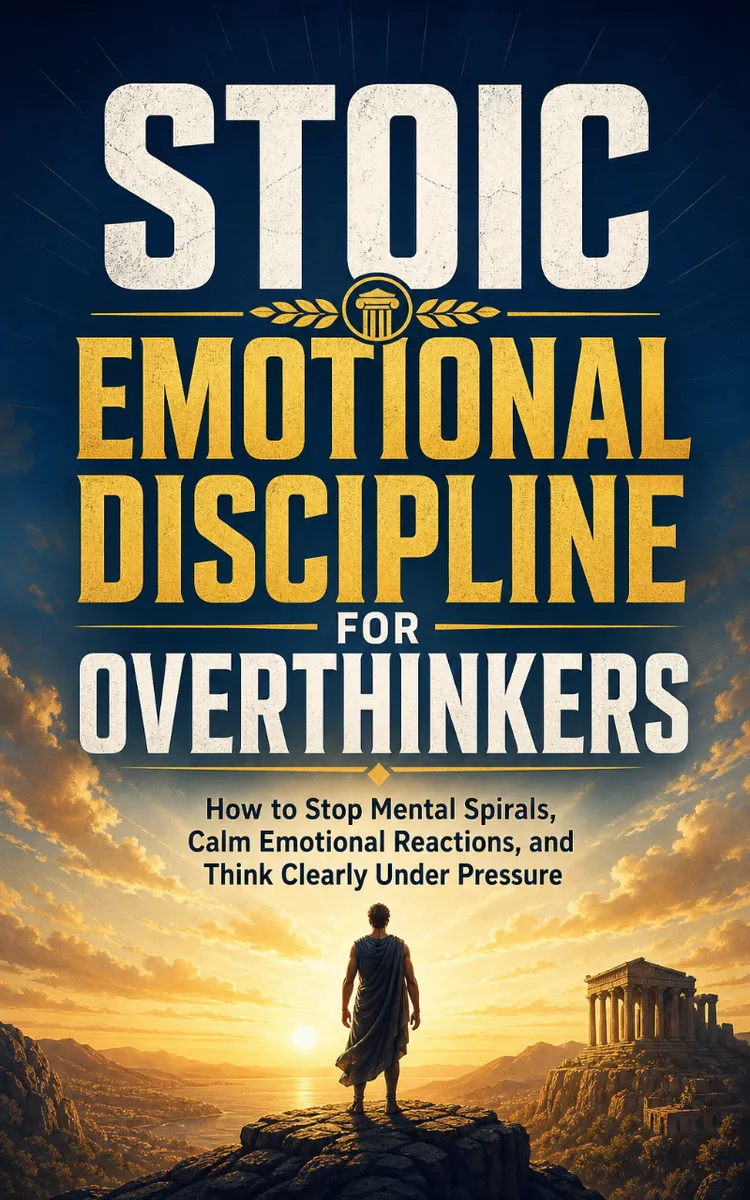
Stoic Emotional Discipline For Overthinkers
Created with Inkfluence AI
Stoic methods to manage rumination and emotional reactivity
Table of Contents
- 1. Spot Your Emotional Spiral Triggers
- 2. Separate What You Control From Reacting
- 3. Train the Pause Before You Respond
- 4. Replace Rumination With Purposeful Review
- 5. Stop Treating Thoughts as Facts
- 6. Build Your Stoic Emotional Baseline
- 7. Use Negative Visualization Without Spiraling
- 8. Reframe Criticism Into Constructive Signals
- 9. Handle Mistakes With Stoic Accountability
- 10. Choose Virtue Over Winning Arguments
- 11. Say What You Mean Without Overexplaining
- 12. Respond to Pressure With the Duty Lens
- 13. Create Boundaries Without Emotional Guilt
- 14. Break the Perfectionism Trap in Real Time
- 15. Turn Anxiety About the Future Into Plans
- 16. Practice Stoic Self-Talk That Calms
- 17. Develop Resilience With the Premeditation Drill
- 18. Use Journaling to Close the Loop
- 19. Integrate Emotional Discipline Into Daily Habits
- 20. Live a Clear Life Under Any Circumstance
Preview: Spot Your Emotional Spiral Triggers
A short excerpt from “Spot Your Emotional Spiral Triggers”. The full book contains 20 chapters and 28,812 words.
The Pattern
Have you ever noticed you’re not “thinking about a problem” so much as staring at the same thought like it owes you money? You send one message, miss one reply, hear one comment-then your brain starts building a courtroom around it. Evidence appears out of nowhere. Your tone gets sharper in your head. Your chest tightens. And before you know it, you’re reacting like the worst version of the story is already confirmed.
Nadia, 34, customer success manager, described her spiral like this: she’d get a customer email that sounded slightly frustrated. Her first moment was quiet-just a flicker of “Uh-oh.” Then the loop kicked in: she replayed the call from yesterday, zoomed in on her exact wording, and decided the customer must think she’s incompetent. She’d check her inbox again. And again. She’d draft a reply, delete it, rewrite it, then read it like a judge reading testimony. The scariest part? The loop felt responsible. Like, “If I analyze hard enough, I can prevent damage.” But all it really did was pour gasoline on her stress until she couldn’t think clearly.
It usually starts the same way: a small trigger hits, your mind labels it as danger, and then it tries to “solve” the feeling by creating more thoughts. The thoughts aren’t the problem. They’re the engine. And once the engine is running, your emotions take the steering wheel. You don’t just feel annoyed-you argue with reality until reality changes shape in your head. So tell me honestly: do you recognize that moment where the thought loop starts before your emotions fully take over?
A New Perspective
What if your spiral isn’t your “mind working”-it’s your mind trying to protect you with the wrong tool?
That question changes everything, because it pulls you out of the “Why am I like this?” story and into a more useful one: “What is my mind doing right now, and what is it trying to accomplish?” Stoics didn’t treat emotions as enemies. They treated them as signals-messages from your judgment. The problem is when the signal arrives with a megaphone and you start obeying it like it’s a reliable officer.
Here’s Nadia’s before-and-after. Before, she’d get the frustrated email, then her brain would immediately treat it as proof she was failing. She’d loop through the past call, then she’d draft a reply that sounded defensive (even if she didn’t mean it to). The customer replied again-this time with more friction-because the tone she sent made the conversation harder. After, she caught the loop earlier using a simple shift: she asked herself, “What am I trying to protect right now?” The answer wasn’t “my customer.” It was “my reputation.” Once she saw that, she could choose a steadier response: she wrote the reply she would send if she didn’t need her competence to be witnessed. Same facts, different judgment. Less pressure. Clearer words.
The Trigger-Loop Map is built on this exact idea: your mind creates a loop to manage discomfort. It’s not random. It’s a pattern. When you stop treating the loop like truth and start treating it like an attempted rescue operation, you regain choice.
Breaking It Down
Your spiral usually follows a predictable cause-and-effect chain. Here’s what it looks like when Nadia’s loop runs in full swing, and then what it looks like when she interrupts it using the Trigger-Loop Map.
1. When you notice a trigger (a slightly sharp email, a pause in someone’s response, a tone change in a coworker’s voice) you treat it like danger in disguise-not just information.
2. You feel a jolt of heat in your body (tight chest, quick pulse, the urge to “fix it now”).
3. So you search for confirmation by replaying old moments and scanning for “what this really means,” like you’re fact-checking a threat.
4. Which leads to a loop: more thoughts, stronger emotion, and a reply or action that comes out messier than you wanted.
Now compare the alternative chain-the same trigger, different handling:
1. When you notice a trigger, you label it plainly in your head: “This is the start of my loop.” (Not “This proves I’m failing.” Just “start.”)
2. You feel the jolt, but you don’t negotiate with the story yet. You let the feeling be a signal, not a verdict.
3. So you map it: “Trigger → Loop Topic → Loop Job.” For Nadia it was often: “Frustrated email → I’m incompetent → prevent damage by over-explaining.”
4. Which leads to a pause long enough to choose. She slows her reply down, writes one version, then waits 10 minutes before sending-just long enough for the loop to lose momentum.
La différence clé : you don’t stop emotion-you catch the moment the loop starts lying.
Check In With Yourself
Let’s get specific. Rate yourself honestly-no performance, no drama. Just data.
1. On a scale of 1-10, how fast do you notice the loop starting?
If you’re at 1-2, you’re usually living inside the loop before you realize it....
About this book
"Stoic Emotional Discipline For Overthinkers" is a self-help book by Socratic Mastery with 20 chapters and approximately 28,812 words. Stoic methods to manage rumination and emotional reactivity.
This book was created using Inkfluence AI, an AI-powered book generation platform that helps authors write, design, and publish complete books. It was made with the AI Self-Help Book Writer.
Frequently Asked Questions
What is "Stoic Emotional Discipline For Overthinkers" about?
Stoic methods to manage rumination and emotional reactivity
How many chapters are in "Stoic Emotional Discipline For Overthinkers"?
The book contains 20 chapters and approximately 28,812 words. Topics covered include Spot Your Emotional Spiral Triggers, Separate What You Control From Reacting, Train the Pause Before You Respond, Replace Rumination With Purposeful Review, and more.
Who wrote "Stoic Emotional Discipline For Overthinkers"?
This book was written by Socratic Mastery and created using Inkfluence AI, an AI book generation platform that helps authors write, design, and publish books.
How can I create a similar self-help book?
You can create your own self-help book using Inkfluence AI. Describe your idea, choose your style, and the AI writes the full book for you. It's free to start.
Write your own self-help book with AI
Describe your idea and Inkfluence writes the whole thing. Free to start.
Start writingCreated with Inkfluence AI


